



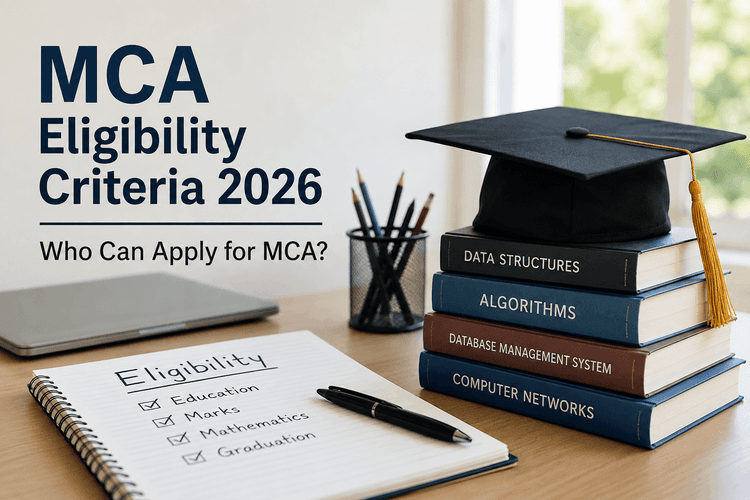
MCA eligibility criteria in 2026 generally require candidates to have a recognised bachelor's degree. Mathematics is an important eligibility requirement at many universities and entrance examinations and may need to have been studied at the 10+2 or graduation level. BCA students are commonly eligible, while B.Sc. and graduates from other disciplines may also qualify depending on the admission rules of the university or institution.
The exact requirements, minimum marks and admission route can vary. Therefore, students should always check the latest eligibility rules of the college, university or entrance examination before applying.
Introduction
Are you planning to pursue a career in software development, data science, artificial intelligence or other technology-related fields? If yes, a Master of Computer Applications can be a valuable postgraduate option.
However, before applying, many students have important questions:
Can a BCA student apply for MCA?
Can I pursue MCA after B.Sc.?
Is Mathematics compulsory for MCA?
Can students from other graduation streams apply?
Can I do MCA without BCA?
Is lateral entry available after BCA?
This guide explains the MCA eligibility criteria 2026 and who can apply for an MCA programme.
Students looking for a postgraduate computer applications programme can also explore the MCA College in Ghaziabad at IPEM.
MCA Eligibility Criteria 2026 at a Glance
Eligibility Factor General Requirement
Educational Qualification Recognised bachelor's degree
Preferred Background BCA, B.Sc. Computer Science/IT and related disciplines
Mathematics Requirement May be required at 10+2 or graduation level, depending on the institution
Minimum Marks Varies by university/institution
Final-Year Students May be eligible subject to institutional rules
Entrance Exam Depends on admission route and institution
Direct Admission Available only where permitted under applicable norms
Lateral Entry Not universal; check institution and university rules
Important: There is no single MCA eligibility rule applicable to every college in India. For example, the current NIMCET 2026 eligibility rules are specific to participating NITs and IIITs, while institutional and university rules can differ.
What Is the Basic Eligibility for MCA?
The most common starting requirement for MCA admission is a bachelor's degree from a recognised university or institution.
However, the following factors may affect eligibility:
Your graduation discipline
Whether you studied Mathematics
Your marks in the qualifying degree
The university's admission rules
The entrance examination requirements
The admission category or route
Therefore, students should not assume that completing any graduation degree automatically guarantees eligibility everywhere.
Can BCA Students Apply for MCA?
Yes, BCA Is One of the Most Common Pathways to MCA Students who have completed a Bachelor of Computer Applications (BCA) are commonly eligible to pursue an MCA, subject to the admission requirements of the institution.
BCA provides students with a foundation in areas such as:
Programming
Database Management
Web Technologies
Operating Systems
Computer Networks
Software Development
Because of this academic background, BCA graduates generally have a strong foundation for postgraduate studies in computer applications.
Is BCA Required for MCA?
No. BCA is not the only degree through which students can become eligible for MCA.
Students from other academic backgrounds may also qualify if they meet the required academic and Mathematics criteria of the specific university or institution.
Can B.Sc. Students Apply for MCA?
Yes, Many B.Sc. Graduates Can Apply
B.Sc. students may be eligible for MCA, particularly if they have studied subjects related to:
Computer Science
Information Technology
Mathematics
Statistics
Computer Applications
However, eligibility should always be checked according to the specific programme and university rules.For certain MCA admissions, Mathematics or Statistics studied during the qualifying degree may be particularly important. The NIMCET 2026 eligibility framework, for example, specifies accepted qualifying degrees and Mathematics/Statistics requirements for participating institutions.
Can a General B.Sc. Graduate Apply?
Possibly, but it depends on:
The subjects studied during graduation
Mathematics background
The institution's eligibility policy
The applicable university or entrance-exam rules
Therefore, students should check the exact eligibility notification before applying.
Can Students from Other Graduation Streams Apply for MCA?
This is one of the most common questions regarding MCA eligibility criteria.
Some institutions allow graduates from disciplines other than BCA or B.Sc. Computer Science, provided that they fulfil the required Mathematics criteria and other academic conditions.
Depending on the university, students from backgrounds such as the following may be considered:
B.Com.
B.A.
B.Sc.
Engineering
Other recognised bachelor's degree programmes
However, eligibility is institution-specific.
Students from non-computer backgrounds may also need additional preparation in areas such as:
Programming fundamentals
Computer fundamentals
Data structures
Mathematics
Logical reasoning
Database concepts
Can I Do MCA After B.Com.?
You should check whether the specific institution accepts your degree and whether you satisfy its Mathematics requirement.
Can I Do MCA After B.A.?
A B.A. graduate may be eligible at institutions that accept graduates from different disciplines, subject to Mathematics and other programme-specific requirements.
The Important Rule
Your graduation stream alone does not determine MCA eligibility. The complete eligibility criteria must be checked.
Is Mathematics Compulsory for MCA?
Mathematics Is an Important Requirement
For many MCA programmes and entrance examinations, Mathematics is an important eligibility requirement.
Depending on the institution, Mathematics may need to have been studied:
At the 10+2 level, or
During graduation
The exact requirement varies. For example, the current NIMCET 2026 framework includes Mathematics/Statistics requirements for its participating institutes.
Why Is Mathematics Important for MCA?
An MCA programme can involve concepts related to:
Algorithms
Logical reasoning
Data structures
Computational thinking
Statistics
Programming logic
Therefore, a Mathematics background may be required to ensure that students have the necessary academic foundation.
What If You Did Not Study Mathematics?
Do not assume that you are automatically ineligible everywhere.
Instead:
Check whether Mathematics was studied at 10+2.
Check whether it was studied during graduation.
Review the official eligibility rules of the university.
Contact the admission department if clarification is needed.
Do not rely only on general internet eligibility lists when applying.
Can I Pursue MCA Without a BCA Degree?
Yes, in Many Cases
You do not necessarily need a BCA degree to pursue MCA.
Depending on the university and admission rules, students from backgrounds such as:
B.Sc. Computer Science
B.Sc. Information Technology
B.Sc. Mathematics
B.Tech.
Other recognised bachelor's programmes meeting required conditions
may be eligible.
The important factor is whether you meet the complete MCA admission eligibility criteria.
Students without a computer applications background should be prepared to strengthen their knowledge of programming and computer fundamentals before beginning an MCA programme.
MCA Eligibility After BCA
For a BCA graduate, the progression from BCA to MCA is a common academic pathway.
An MCA programme can help students develop more advanced knowledge in areas such as:
Software Development
Artificial Intelligence
Data Science
Cloud Computing
Cybersecurity
Database Systems
Advanced Programming
Students considering this pathway should review the MCA programme in Ghaziabad Land check the current admission requirements before applying.
Minimum Marks Required for MCA
There is no single minimum percentage that applies to every MCA programme.
The required marks can depend on:
University guidelines
Institution rules
Category of the candidate
Entrance examination requirements
Applicable government regulations
Some universities may specify a minimum percentage, while others may have different admission criteria.
Therefore, before applying, check:
What is the minimum qualifying percentage required for the specific MCA programme?
This is more reliable than following a generic percentage requirement for all colleges.
Are Final-Year Students Eligible for MCA Admission?
In many cases, students who are in the final year of their bachelor's degree may apply, subject to the rules of the institution or entrance examination.
However, candidates may be required to:
Complete their qualifying degree by a specified date
Submit final marksheets
Meet the minimum eligibility requirements
Provide relevant documents during admission
NIMCET 2026, for example, has specific provisions for candidates who have completed or are completing their qualifying degree.
Always check the latest admission notification.
MCA Direct Admission: Is It Possible?
The term direct admission can have different meanings depending on the college and university.
At IPEM, the current MCA page states that direct admissions are based on merit in qualifying examinations, subject to applicable directives and norms of the UP State Government, AICTE and AKTU.
This means students should understand:
Eligibility must still be satisfied
Direct admission does not mean eligibility requirements can be ignored
Admission must follow applicable institutional and university norms
Rules can change according to the academic session
For the latest details, students can check the MCA Admission Process IPEM Admission Page.
Is Lateral Entry Available in MCA?
Do Not Assume Every BCA Student Gets Direct Second-Year MCA Admission
Lateral-entry rules for MCA are not universal.
Some students believe:
BCA completed = automatic direct entry into the second year of MCA.
This is not a universal rule.
The availability of lateral entry can depend on:
State regulations
University policy
Programme structure
Admission rules for that academic session
Students should verify whether lateral entry is officially available for the specific programme before making admission decisions.
Direct Admission and Lateral Entry Are Different
Direct Admission Lateral Entry
Admission through a direct institutional/merit route where permitted Entry into an advanced semester or year
Usually follows applicable admission norms Depends on a specific programme structure and policy
Does not automatically mean second-year entry Must be specifically allowed by the university
For IPEM MCA admissions, follow the official admission and university guidelines rather than assuming that BCA automatically provides lateral entry.
MCA Eligibility Checklist 2026
Before applying, use this checklist:
Academic Qualification
☑ Do I have a recognised bachelor's degree?
Graduation Background
☑ Does my graduation programme meet the institution's eligibility rules?
Mathematics
☑ Did I study Mathematics at 10+2 or graduation level, where required?
Minimum Marks
☑ Do I meet the minimum percentage or CGPA requirement?
Entrance Examination
☑ Is an entrance examination required for my preferred admission route?
Documents
☑ Are my marksheets and certificates available?
Final-Year Status
☑ If I am awaiting final results, am I permitted to apply?
Programme Rules
☑ Have I checked the official 2026 eligibility notification?
How to Check Your MCA Eligibility in 5 Steps
Step 1: Identify Your Graduation Degree
Write down your exact qualification.
For example:
BCA
B.Sc. Computer Science
B.Sc. IT
B.Com.
B.A.
B.Tech.
Step 2: Check Your Mathematics Background
Check whether you studied Mathematics:
In Class 12
During graduation
In both
This can be important for MCA eligibility.
Step 3: Check the Minimum Marks Requirement
Review the current admission criteria of the institution.
Do not rely on outdated eligibility information from previous years.
Step 4: Check the Admission Route
Understand whether admission is through:
University counselling
Entrance examination
Merit-based admission where permitted
Other approved admission processes
Step 5: Confirm Before Applying
If you are unsure about your eligibility, contact the admission department and provide your academic background for confirmation.
How to Choose an MCA College After Checking Eligibility
Meeting the eligibility criteria is only the first step. Students should also evaluate:
Curriculum
Faculty
Technology infrastructure
Practical learning
Industry exposure
Internship opportunities
Placement support
Location
Fees
University affiliation and applicable approvals
Students searching for an MCA College in Ghaziabad can explore IPEM's MCA programme and compare its course structure and admission requirements with their academic background.
Frequently Asked Questions About MCA Eligibility
Can I do MCA after BCA?
Yes. BCA is one of the most common academic pathways to MCA, subject to the eligibility and admission requirements of the specific institution.
Can I do MCA after B.Sc.?
Yes, many B.Sc. graduates may be eligible for MCA, especially students with Computer Science, IT, Mathematics or related backgrounds. The exact requirements depend on the institution.
Is Mathematics compulsory for MCA?
Mathematics is an important requirement for many MCA programmes and entrance examinations. Depending on the institution, it may need to have been studied at the 10+2 or graduation level.
Can I do MCA without Mathematics?
This depends on the specific university or institution. Some admission rules require Mathematics at the 10+2 or graduation level, so candidates should check the official programme eligibility criteria before applying.
Can I do MCA without BCA?
Yes. A BCA degree is not the only route to MCA. Other eligible bachelor's degrees may also be accepted, depending on the institution's academic and Mathematics requirements.
What is the minimum percentage required for MCA?
The minimum percentage varies by university and institution. Always check the official eligibility requirements for the specific MCA programme.
Can final-year students apply for MCA?
Many institutions and entrance examinations allow final-year students to apply, subject to conditions such as completing the qualifying degree and submitting proof of passing by the specified deadline.
Does BCA give direct second-year entry into MCA?
Not automatically. Lateral-entry rules vary by university and programme. Students should verify whether such an option is officially available.
Conclusion
The MCA eligibility criteria 2026 can vary between universities, institutions and entrance examinations. However, the main factors students should check are their bachelor's degree, academic background, Mathematics qualification, minimum marks and applicable admission route.BCA students commonly have a direct academic pathway to MCA, while B.Sc. and other graduates may also qualify if they meet the requirements of the specific programme.
The best approach is simple: check your academic qualifications first, verify the latest official eligibility rules and then select the right MCA programme for your career goals.
If you are planning to pursue a postgraduate programme in computer applications, explore the MCA College in Ghaziabad at IPEM and check the latest admission process for the 2026 academic session.