



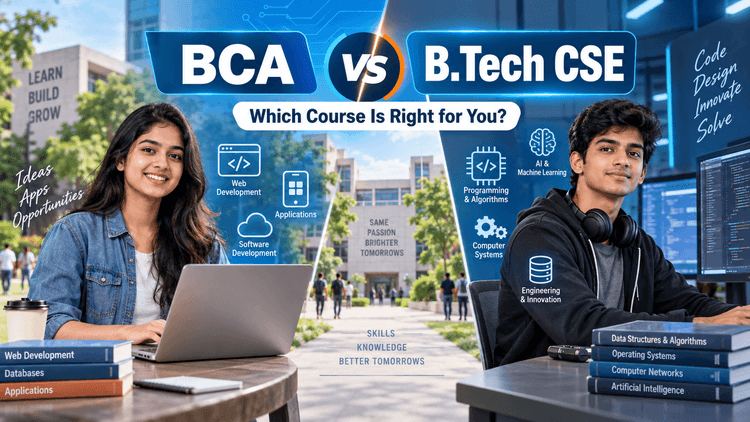
Choosing the right course after Class 12 is an important decision, especially for students interested in coding, software development and technology. BCA and B.Tech CSE are two popular courses that can lead to careers in the IT industry.
Although both programmes cover computer-related subjects, they differ in duration, eligibility, fees, curriculum and career approach. BCA mainly focuses on computer applications and software development, whereas B.Tech CSE provides a broader engineering education.
Understanding these differences can help you select the course that matches your interests, academic background, budget and career goals.
What Is BCA?
BCA stands for Bachelor of Computer Applications. It is an undergraduate programme that introduces students to programming, databases, web development, software engineering and computer networks.
The course is suitable for students who want to build careers in software and information technology. Since it mainly focuses on computer applications, students can begin studying programming and software-related subjects from the early stages of the programme.
A traditional BCA course is usually completed in three years. However, the duration and structure may vary under the academic framework followed by a particular university.
Students from Science, Commerce and other eligible streams may apply for BCA. Some universities require Mathematics, Computer Science or another relevant subject in Class 12. Therefore, students should check the latest eligibility requirements before applying.
What Is B.Tech CSE?
B.Tech CSE stands for Bachelor of Technology in Computer Science and Engineering. It is a four-year engineering programme covering computer science, programming, mathematics, computer systems and engineering concepts.
Students study subjects such as data structures, algorithms, operating systems, computer architecture, database management, networking and software engineering. The curriculum may also include engineering mathematics, electronics and other foundation subjects.
B.Tech CSE is primarily suitable for students who studied Physics, Chemistry and Mathematics in Class 12. Admission may be based on JEE, a state-level entrance examination or a university-specific process.
BCA vs B.Tech CSE: Key Differences
Course Duration
BCA is usually a three-year undergraduate programme, allowing students to complete their degree and enter the job market comparatively earlier.
B.Tech CSE requires four years of study. The additional year provides more time for engineering subjects, technical projects, internships and specialised learning.
Eligibility
BCA eligibility varies between universities. Students from different academic streams may be accepted, although some institutions require Mathematics or Computer Science in Class 12.
For B.Tech CSE, students generally need Physics, Chemistry and Mathematics in Class 12. They may also need to qualify through an engineering entrance examination.
Curriculum Focus
BCA primarily focuses on software applications, programming, databases, web development and computer fundamentals. It is a direct option for students interested mainly in software-based careers.
B.Tech CSE combines software development with engineering mathematics, algorithms, computer architecture and hardware-related concepts. It provides a broader understanding of computer science and engineering.
Course Fees
BCA is generally more affordable because of its shorter duration and programme structure. It can be a practical option for students seeking technology education with a manageable financial investment.
B.Tech CSE fees are usually higher, particularly at private engineering colleges. Students should compare total fees, placement records and available facilities before selecting an institution.
Higher-Education Options
After BCA, students can pursue MCA, MBA, M.Sc. IT or specialised certifications in areas such as cloud computing, cybersecurity and data analytics.
B.Tech CSE graduates can pursue M.Tech, MS, MBA or advanced certifications in different technology specialisations.
Advantages of Choosing BCA
One of the biggest advantages of BCA is its software-focused curriculum. Students learn programming, databases, web technologies and software development without spending extensive time on unrelated engineering subjects.
Its shorter duration also allows students to begin working or continue with higher education sooner. Students who use their college years to complete internships and build practical projects can enter the job market with relevant experience.
BCA is also generally more affordable than B.Tech CSE. It can be especially useful for students who want a career in technology but do not have a PCM background.
However, students should not depend only on classroom learning. They must practise coding, develop projects, participate in technical activities and improve their communication skills.
Advantages of Choosing B.Tech CSE
B.Tech CSE provides a comprehensive understanding of computer science and engineering. Along with software development, students learn about algorithms, computer systems, hardware architecture and advanced mathematics.
Some organisations and specialised technical positions may prefer candidates with an engineering qualification. B.Tech CSE can therefore provide access to a wider range of software and engineering roles.
The four-year structure also gives students more time to participate in internships, hackathons, research projects and coding competitions. Students interested in artificial intelligence, robotics, embedded systems or technical research may benefit from its broader curriculum.
Career Opportunities After BCA
BCA graduates can apply for several entry-level IT roles, including:
Software Developer
Web Developer
Front-End Developer
Back-End Developer
Junior Full-Stack Developer
Software Tester
Database Administrator
Technical Support Executive
Cloud Support Associate
Junior Data Analyst
Cybersecurity Associate
Career growth depends on technical knowledge, projects, internships and work experience. Maintaining a GitHub profile and developing real applications can help students demonstrate their abilities to employers.
Career Opportunities After B.Tech CSE
B.Tech CSE graduates can explore software and engineering positions such as:
Software Engineer
Systems Engineer
Full-Stack Developer
Data Engineer
Cloud Engineer
DevOps Engineer
Cybersecurity Analyst
Machine Learning Associate
Network Engineer
Embedded Systems Engineer
Eligibility differs across employers. Students should develop skills that match the requirements of their preferred roles.
Can BCA Graduates Compete with B.Tech Graduates?
Yes, BCA graduates can compete with B.Tech graduates for many software and IT positions. Employers often assess candidates through coding tests, technical interviews, practical assignments and project portfolios.
A BCA student with strong programming, problem-solving and database skills may perform better than an engineering graduate who lacks practical experience.
However, certain employers or specialised positions may specifically require an engineering qualification. BCA graduates can strengthen their profiles through an MCA, professional certifications, internships and relevant work experience.
Why Choosing the Right College Matters
The quality of your education depends greatly on the institution you choose. Before taking admission, evaluate the curriculum, faculty, computer laboratories, placement support, internship opportunities and industry exposure.
Students searching for a BCA college in Ghaziabad can explore the programme offered by IPEM Group of Institutions. Applicants should review the latest course structure, eligibility criteria and facilities before applying.
When comparing options for a top BCA college in Ghaziabad, students should also consider practical training, coding activities, student projects and verified placement information.
Which Course Should You Choose?
Choose BCA if you want a software-focused and comparatively affordable course, wish to complete your undergraduate studies sooner or do not have a PCM background but meet the institution’s eligibility criteria.
Choose B.Tech CSE if you studied PCM, want an engineering degree and are interested in both software and broader computer engineering concepts.
Final Verdict
Neither course is automatically better for every student. BCA offers a focused and affordable pathway into software careers, while B.Tech CSE provides a broader engineering foundation.
Your future success will depend on your coding ability, practical projects, internships, communication skills and willingness to keep learning. Choose the programme that suits your circumstances and then focus on developing the skills demanded by the IT industry.
Frequently Asked Questions
Is BCA suitable for software development?
Yes. BCA covers programming, databases, web technologies and software applications. Practical projects and internships are also important for becoming job-ready.
Is Mathematics compulsory for BCA?
It depends on the university. Some institutions require Mathematics or Computer Science, while others accept students from different streams.
Is MCA compulsory after BCA?
No. BCA graduates can apply for entry-level jobs directly. However, MCA can provide deeper technical knowledge and improve eligibility for certain roles.
Can a BCA graduate earn the same salary as a B.Tech graduate?
Yes, it is possible. Salary depends on skills, experience, employer, job role and location rather than the degree alone.