




Every year, hundreds of thousands of graduates across Delhi NCR and India prepare for management entrance exams with a singular goal: to break into high-growth corporate careers. Yet, as admission counseling begins, students and their families face an intense financial dilemma:
"Should you take an education loan of ₹15 to ₹20 Lakhs for a private PGDM diploma, or should you pursue an affordable, state-university-affiliated MBA degree for ₹2.5 to ₹3 Lakhs?"
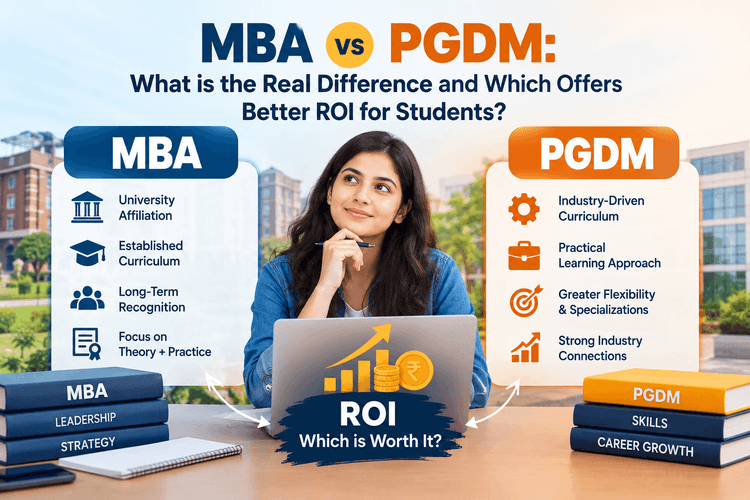
Glossy marketing brochures often portray Post Graduate Diploma in Management (PGDM) and Master of Business Administration (MBA) as interchangeable credentials. However, behind the corporate buzzwords lie critical differences in legal accreditation, long-term educational mobility, student debt burdens, and actual financial Return on Investment (ROI).
If you are evaluating management programs for the upcoming academic session, this honest guide breaks down the structural differences between an MBA and a PGDM to help you make a financially sound decision.
1. The Foundational Difference: Degree vs Diploma
The most fundamental distinction between MBA and PGDM comes down to legal academic recognition and regulatory jurisdiction:
MBA (Master of Business Administration): A Recognized University Post-Graduate Degree
Awarded exclusively by universities established by Central or State Acts (such as Dr. A.P.J. Abdul Kalam Technical University, AKTU) or colleges permanently affiliated with them.
Recognized under the University Grants Commission (UGC) and approved by the All India Council for Technical Education (AICTE).
Holds statutory global equivalence as a formal master's degree.
PGDM (Post Graduate Diploma in Management): An Autonomous Institutional Diploma
Awarded by standalone private business schools and autonomous institutes approved by AICTE.
It is formally a post-graduate diploma, not an academic university degree (unless specifically accredited by the Association of Indian Universities, AIU).
The curriculum is created internally by the individual institute's board.
2. Parameter-by-Parameter Comparison: MBA vs PGDM
1. Financial Investment & Tuition Costs
University MBA: Substantially lower and student-friendly. In reputed private institutions affiliated with state universities like AKTU, the entire 2-year tuition typically ranges between ₹2.5 Lakhs to ₹3.5 Lakhs.
Private PGDM: High to exorbitant. Standard tuition in private B-schools across Delhi NCR averages ₹12 Lakhs to ₹20 Lakhs, excluding hostel and living overheads.
2. Education Loan & Debt Burden
University MBA: Often manageable through family savings or small education loans with negligible monthly EMIs, leaving freshers debt-free within 1 to 2 years.
Private PGDM: Demands massive bank loans (often ₹12–15 Lakhs at 10%–12% interest). Graduates begin their corporate careers saddled with monthly EMIs of ₹20,000 to ₹30,000 for 7 to 10 years.
3. Government Jobs & Public Sector (PSU) Eligibility
University MBA: 100% accepted across all Union Public Service Commission (UPSC), State Public Service Commission (UPPSC), Banking (IBPS/SBI Specialist Officer), and Public Sector Undertaking (PSU) recruitments where a formal master's degree is mandated.
Private PGDM: Can encounter complex verification scrutiny or outright rejection unless the institute possesses explicit AIU equivalence certification at the time of graduation.
4. Higher Studies (PhD & Global Work Visas)
University MBA: Seamlessly recognized worldwide. If you plan to pursue a Ph.D. in Management, enter academic professorships, or apply for point-based international work visas (in countries like Canada, the UK, or Germany), an accredited university master's degree is universally recognized.
Private PGDM: Evaluating foreign credential equivalence (such as WES evaluation for global immigration) can be complicated, often evaluating standalone diplomas as post-secondary diplomas rather than full master's degrees.
5. Curriculum Flexibility & Industry Alignment
University MBA: Delivers a structured, university-regulated framework covering foundational corporate theory alongside Dual Specializations (e.g., Marketing + Finance, or HR + Business Analytics).
Private PGDM: Can update elective subjects rapidly to reflect seasonal industry trends.
3. The Mathematics of ROI: A Real-World Calculation
The true value of any professional course is determined by its Return on Investment (ROI)—the relationship between what you invest and what you take home after graduation.
Consider this realistic comparison of two management graduates starting their corporate journeys in Delhi NCR:
Scenario A: The Private PGDM Graduate
Total Financial Outlay: ₹16,00,000 (Tuition + Living expenses)
Education Loan Taken: ₹12,00,000 at 10.5% interest for 7 years
Monthly Loan EMI: ~₹20,500/month
Campus Placement CTC: ₹7,50,000 LPA (Gross Take-Home: ~₹50,000/month)
Actual Disposable Income: ₹50,000 - ₹20,500 (EMI) - Living Costs = ₹10,000 to ₹15,000/month
Time Required to Clear Debt: 7 Full Years
Scenario B: The University MBA Graduate
Total Financial Outlay: ₹2,90,000 (Complete 2-Year Program)
Education Loan Taken: ₹0 to ₹1,50,000 (Minimal loan, often self-funded or cleared via summer internships)
Monthly Loan EMI: ₹0 to ₹2,500/month
Campus Placement CTC: ₹5,50,000 LPA (Gross Take-Home: ~₹38,000/month)
Actual Disposable Income: ₹38,000 - Minimal EMI = ₹25,000 to ₹30,000/month
Time Required to Achieve Financial Freedom: Day 1 to 6 Months
The Reality Check: While a top-tier PGDM may yield a marginally higher starting salary, the crushing burden of a ₹15 Lakh loan drastically reduces a graduate's actual disposable income and corporate risk-taking appetite. Within 3 years of corporate performance, individual capability and project delivery level out salary differences entirely.
4. Why Choosing the Right Campus in Ghaziabad Matters
An affordable degree should never mean compromising on corporate grooming, digital tool mastery, or campus placement drives. The sweet spot for management aspirants is enrolling in an AICTE-approved, university-affiliated institution that combines affordable fee structures with rigorous industry interfaces.
For students targeting Delhi NCR, selecting an affordable MBA college in Ghaziabad provides the ideal blend of financial sanity and professional career acceleration. Institutions like IPEM Group of Institutions deliver an AICTE-approved, AKTU-affiliated full-time MBA program featuring:
Dual Specialization options in Marketing, Finance, Human Resource Management, and Information Technology
Practical corporate certifications in high-demand business tools like Power BI, Advanced MS Excel, and Marketing Analytics
A proven corporate network securing internships and campus recruitment drives with major conglomerates (including Deloitte, HDFC Bank, ICICI Bank, Dabur, and Genpact)
Comprehensive tuition around ₹1.45 Lakhs per year, ensuring graduates enter the corporate world with high ROI and zero crippling debt
Enrolling in IPEM's AKTU-affiliated MBA program gives students a legitimate university degree recognized by corporate recruiters, public sector bodies, and international institutions alike.
5. The Final Verdict: Which One Should You Choose?
Choose a Private PGDM if: You have secured admission to India's top 10–15 elite business schools (such as IIMs, XLRI, or SPJIMR), have guaranteed corporate sponsorships, and your family can absorb the high tuition without financial strain.
Choose a University MBA if: You want a high-ROI, cost-effective management education, value an officially recognized master's degree valid for government examinations and doctoral studies, and desire to enter the corporate workforce with zero loan-repayment anxiety.
Frequently Asked Questions (FAQs)
Q1. Is an MBA degree more valuable than a PGDM for government jobs?
Ans: Yes. Central and state government bodies (including UPSC, State Public Service Commissions, banking sector SO positions, and PSUs) strictly mandate a recognized university master's degree. A PGDM requires explicit AIU equivalence certification to be considered valid for such positions.
Q2. Do top corporate companies hire university MBA graduates?
Ans: Absolutely. Private corporate recruiters evaluate candidates on communicative clarity, analytical capability, domain specialization, and problem-solving skills. Leading brands like HDFC Bank, Deloitte, ICICI, and Genpact regularly recruit MBA graduates from recognized university-affiliated institutions.
Q3. What is the fee structure for an AKTU-affiliated MBA in Ghaziabad?
Ans: An AKTU-affiliated MBA in Ghaziabad typically costs approximately ₹1.3 Lakhs to ₹1.5 Lakhs per year, making the total 2-year investment under ₹3 Lakhs, which is a fraction of typical private PGDM fees.
Q4. Which is the premier institute for affordable MBA programs in Ghaziabad?
Ans: IPEM Group of Institutions is recognized among the premier MBA colleges in Ghaziabad, offering an AICTE-approved and AKTU-affiliated 2-year MBA with dual specializations, industry certifications, and dedicated corporate placement assistance.