




Completing Class 12th opens the door to one of the smartest academic shortcuts in legal education: 5-year integrated law courses after 12th. Instead of spending three years on a traditional graduation degree followed by another three years for an LL.B. (six years total), an integrated programme combines an undergraduate discipline with core legal studies in just five years—saving you a full academic year.
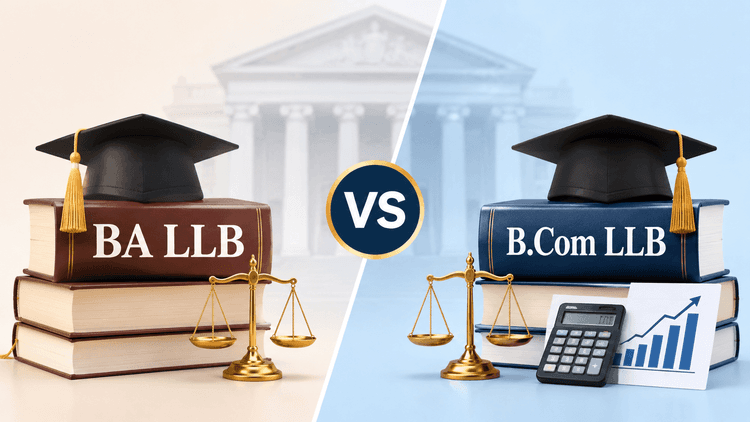
However, once students decide on a 5-year integrated programme, they immediately face a major choice: Should you choose BA LL.B. or B.Com LL.B.?
While both degrees carry the exact same legal recognition from the Bar Council of India (BCI) for court practice, judiciary exams, and corporate hiring, their foundational subjects shape very different career strengths. Here is an objective, practical comparison to help you pick the right programme for your ambitions.
1. Understanding BA LL.B. (Bachelor of Arts + Bachelor of Laws)
BA LL.B. blends humanities and social sciences with core Indian and international legal frameworks across 10 semesters.
Core Non-Law Subjects: Political Science, History, Sociology, Economics, and Legal English.
Core Law Subjects: Constitutional Law, Bharatiya Nyaya Sanhita (BNS), Family Law, Administrative Law, Jurisprudence, and Public International Law.
Why It Matters: Subjects like Political Science and History build strong analytical context for interpreting constitutional articles, legislative intent, and socio-legal disputes.
2. Understanding B.Com LL.B. (Bachelor of Commerce + Bachelor of Laws)
B.Com LL.B. merges commercial finance, business accounting, and corporate governance with statutory legal training across 10 semesters.
Core Non-Law Subjects: Financial Accounting, Corporate Finance, Auditing, Business Economics, Taxation Principles, and Business Statistics.
Core Law Subjects: Company Law, Banking & Insurance Law, Direct & Indirect Taxation (GST), Mergers & Acquisitions, Insolvency & Bankruptcy Code (IBC), and Intellectual Property Rights.
Why It Matters: Understanding balance sheets, tax liabilities, and corporate finance gives B.Com LL.B. graduates a natural edge when advising businesses, banks, and multinational corporations.
3. Parameter-by-Parameter Comparison: BA LL.B. vs B.Com LL.B.
1. Class 12th Stream Suitability
BA LL.B.: Ideal for Arts/Humanities students—and equally comfortable for Science or Commerce students who prefer theory, reading, and social sciences over heavy accounting.
B.Com LL.B.: Best suited for Commerce students (or Science/Arts students comfortable with numbers, accounting, and financial concepts).
2. Judicial Services (PCS-J) & Civil Services (UPSC) Alignment
BA LL.B.: Offers strong syllabus overlap with UP PCS-J, Delhi Judicial Services, and UPSC Civil Services, where Political Science, History, Constitutional Law, and Sociology form major scoring areas.
B.Com LL.B.: Equally eligible for Judiciary and UPSC exams, though students need independent study for humanities-heavy general studies sections.
4. Corporate Law, Banking & Taxation Scope
BA LL.B.: Graduates can enter corporate law firms easily, particularly in dispute resolution, arbitration, and regulatory policy.
B.Com LL.B.: The B.Com LL.B. scope in India is exceptionally strong in Corporate Law Firms, Tax Consultancies (Big 4), Investment Banks, SEBI compliance, and M&A Advisory, because recruiters value lawyers who can read financial statements fluently.
5. Litigation & Court Practice
BA LL.B.: Excellent preparation for Civil, Criminal, Constitutional, and Matrimonial litigation in District Courts, High Courts, and the Supreme Court.
B.Com LL.B.: Strong advantage in Commercial Courts, NCLT (National Company Law Tribunal), Income Tax Appellate Tribunals, and Debt Recovery Tribunals.
6. Starting Salary & Career Growth
Both degrees unlock identical Bar Council registration and pay scales. In Delhi NCR corporate law firms or in-house legal teams, starting packages typically range from ₹4.5 LPA to ₹8+ LPA depending on internship experience, drafting skills, and moot court performance.
7. Which Course Should You Pick? (Quick Decision Checklist)
Choose BA LL.B. if:
You aspire to crack Judicial Services (PCS-J) or UPSC / State Civil Services.
You are passionate about Constitutional Law, Criminal Advocacy, Human Rights, or High Court Litigation.
You come from a Humanities or Science background and prefer conceptual reading over financial accounting.
Choose B.Com LL.B. if:
You come from a Commerce background and enjoy finance, taxation, and business structures.
You aim to work with Corporate Law Firms, MNC Legal Teams, Big 4 Tax Practices, or Banks.
You want to specialize in GST/Income Tax litigation, Corporate Governance, or Company Secretary (CS) alongside law.
8. Why Your Choice of Law Campus Matters Most
Regardless of whether you pick BA LL.B. or B.Com LL.B., real legal competence is built outside textbooks—inside moot court halls, legal aid camps, and courtrooms.
For students in Delhi NCR, studying at the best law college in Ghaziabad offers a major practical advantage: seamless access to District Courts, the Delhi High Court, the Supreme Court of India, and Noida's corporate legal hubs for regular semester internships.
At IPEM Law Academy, students can choose between both 5-year integrated BA LL.B. and B.Com LL.B. programmes—both approved by the Bar Council of India (BCI) and affiliated with Chaudhary Charan Singh University (CCSU), Meerut. With active moot court training, legal research workshops, and dedicated internship support, students graduate courtroom-ready and corporate-ready.
Explore full syllabus details, eligibility criteria, and admission guidelines for both integrated programmes at IPEM Law Academy.
Frequently Asked Questions (FAQs)
Q1. Can a Science or Commerce student apply for BA LL.B. after 12th?
Ans: Yes. Students who have passed 10+2 from any recognized board across Arts, Commerce, or Science streams with the minimum required aggregate marks (typically 45% for General, with relaxation for OBC/SC/ST as per BCI norms) are eligible for BA LL.B.
Q2. Is B.Com LL.B. better than BA LL.B. for corporate law?
Ans: Yes, B.Com LL.B. offers an added advantage for corporate, banking, and taxation law because it trains students in financial accounting, auditing, and business economics alongside core legal statutes.
Q3. Are both BA LL.B. and B.Com LL.B. valid for Judiciary (PCS-J) exams?
Ans: Yes. Both degrees carry equal statutory recognition from the Bar Council of India (BCI) for registering as an advocate, appearing in AIBE, and sitting for all State Judicial Service (PCS-J) examinations.